Does Prof Jeff Morris prefer third rate vaccine pharmacovigilance?
Inversion of the precautionary principle will dismiss all safety signals

Summary:
I received a puzzling reply from Prof Jeffrey Morris on Twitter, suggesting he doesn’t want v-safe free text data to be publicly analyzed, raising questions about his commitment to high quality vaccine pharmacovigilance
This is a list of my previous analysis based on v-safe free text
I successfully extracted structured insights from the open field data, including discovering that over 1,500 v-safe deaths were reported by family members, yet fewer than 25 made it into VAERS despite CDC promises
I confirmed through text analysis that CDC even concealed some v-safe deaths from peer reviewers in their published Lancet paper (in fact, in my opinion that paper should be retracted)
Using the free text data, I calculated that transverse myelitis rates for dose 1 exceeded background rates for both Pfizer and Moderna vaccines
Why are people not noticing this inversion of the precautionary principle?
Recently, I got this bizarre response from Prof Jeffrey Morris on Twitter about v-safe free text
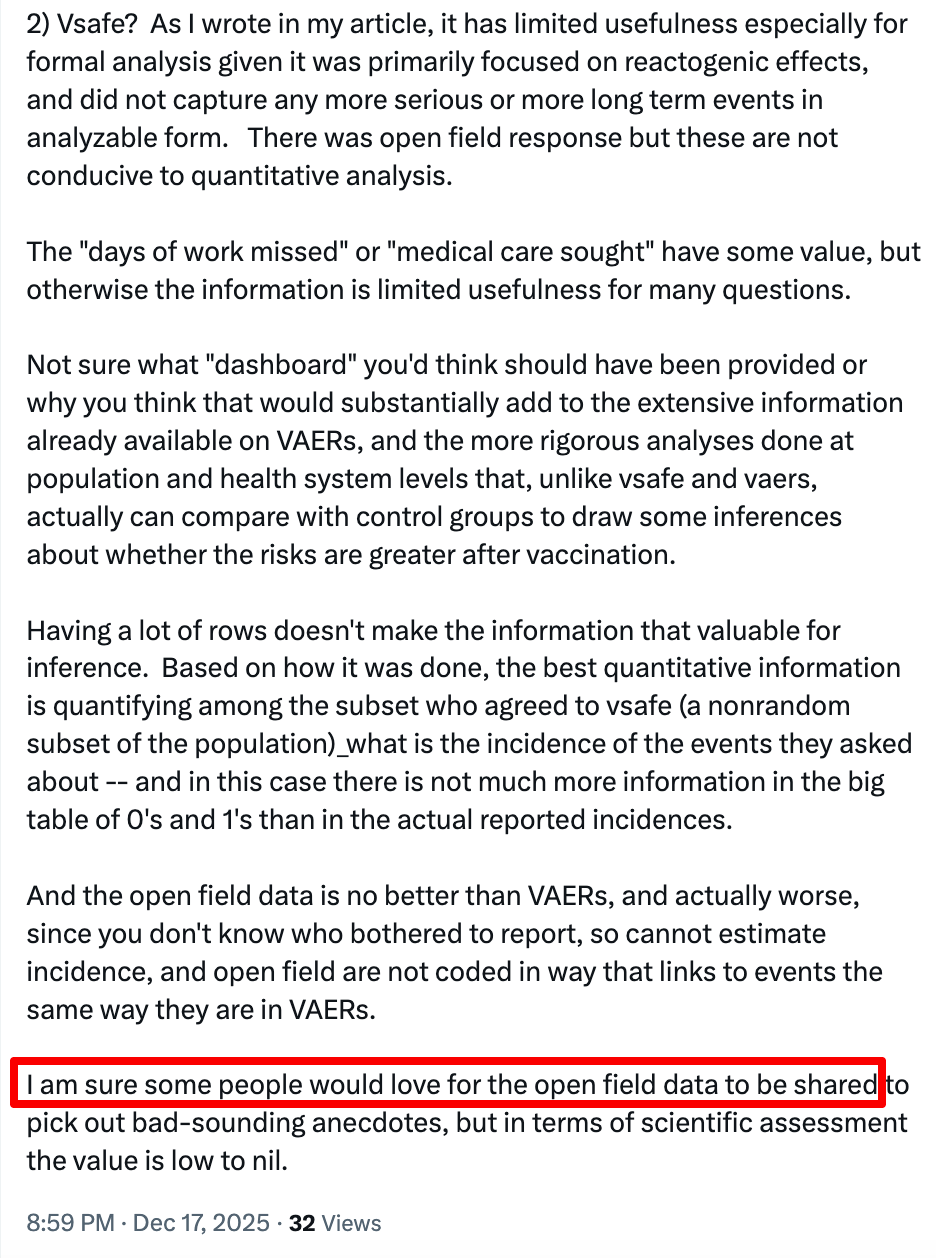
“I am sure some people would love for the open field data to be shared“?
So does Jeff Morris prefer that the open field data is NOT publicly shared and independently analyzed?
Or does he think there is nothing else in the open field data other than “bad sounding anecdotes”?
And how exactly would he know?
By the way, it is also clear to me that Prof Morris does not know many things about prior v-safe data analysis even if we restrict ourselves to regular aka non-text fields. But that’s an article for a future date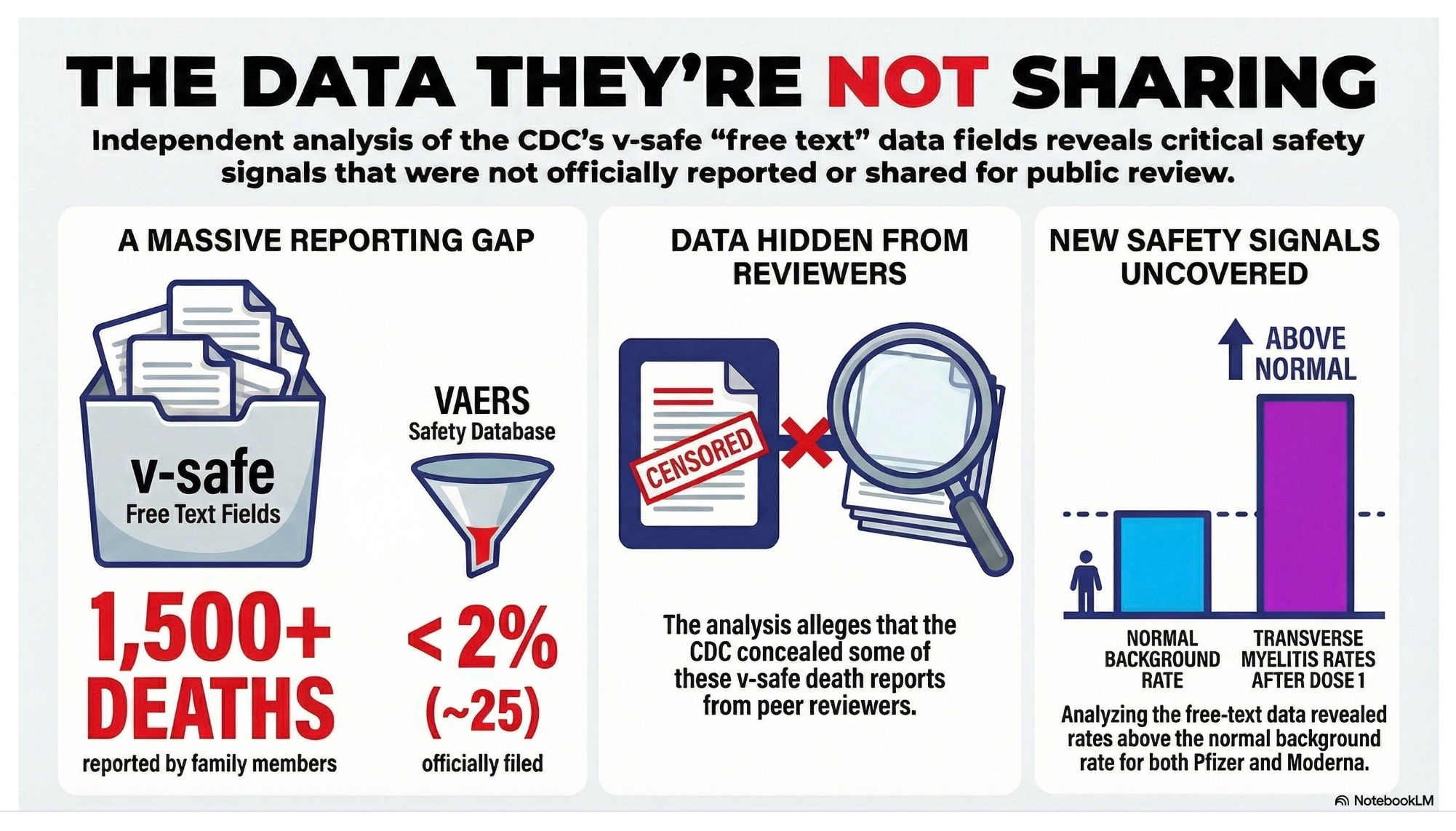
Here are three things I was able to infer using text analysis of the open field data
a) of the 1700+ death reports in v-safe, 1500+ were family members reporting the death of the primary registrant. And only around 25 of them are found in VAERS, even though CDC head Tom Shimabukuro promised to follow up on all serious adverse events and get them reported to VAERS.
To be clear: I don’t mean 25 percent. Only ~25 of the 1500 v-safe primary registrant deaths (less than 2%) were reported to VAERS.
b) using the same technique, I was able to confirm that the CDC hid some v-safe deaths from the paper reviewers in its heavily cited v-safe paper.
Is Prof Morris suggesting that people are somehow better off not knowing about this? Why?
c) I calculated that tranverse myelitis for dose 1 was above background rate for both Pfizer and Moderna
But my bigger concern isn’t whether he agrees with all my v-safe data analysis (although if he doesn’t I would like to at least know why).
Why would ANYONE suggest that the open text field should not be independently analyzed?
After all, it is now well known that you can usually extract some structured data even from unstructured free text. And this has been true to varying degrees for at least 10+ years, but it has now become much easier because of LLMs.
This can be done using many different techniques and I have used them myself for large scale text analysis of VAERS writeups - plain spaCy dependency rules, machine learning models for extracting medical jargon, and nowadays large language models for extracting structured outputs - once you extract this information, you can “attach” it to the corresponding row in the table (VAERS ID) and do quantitative analysis.
a) Does Prof Morris not know about ways to quantify qualitative analysis?
Then he should spend some time looking into it - he can start by reading the articles I have linked
b) If he does know about them, does he have any objection if people use these techniques?
Then he should write up an article or post explaining his objections.
c) Or does he simply not care about it no matter what the result of doing quantitative analysis of qualitative data (such as VAERS and v-safe free text)?
Then he is just accepting and even endorsing third rate pharmacovigilance. While that is his preference, there isn’t much to “debate” with someone who holds that opinion
And if there is some option d) that I haven’t thought of, I would certainly like to know!
Inversion of the precautionary principle will dismiss ALL safety signals
Prof Morris, either intentionally or unintentionally, is endorsing third rate vaccine pharmacovigilance when he says free text information should not be publicly shared and analyzed.
In my opinion, this represents a complete inversion of the precautionary principle.
And my assertion is not just “theoretical”. I even provided an example where the CDC hid v-safe free text deaths from the peer reviewers when it published its Lancet paper. Why is there no curiosity about this? Where are all the calls for retraction?
More importantly, if you invert the precautionary principle like this, you will dismiss ALL safety signals including legitimate ones. How is that a good thing?
You are misrepresenting my viewpoints, and ignoring the content of the white paper.
I never said it should not be analyzed, I just said it was limited usefulness, for the reasons I mentioned in the tweet.
My paper provides specific suggestions to both increase the automatic reporting to VAERs, as well as to make the V-safe system produce data that is more useful for quantitative analysis.